
The Benefits of Diversifying Through Property Ownership
Key Takeaways
- Diversifying with real estate provides stability, reducing reliance on volatile markets.
- Property investments offer both steady income and the potential for capital appreciation.
- Geographic and asset-type diversification within real estate further mitigates risk.
- Tax advantages can enhance overall investment returns for property owners.
- Real estate can serve as a cornerstone for building long-term wealth.
Table of Contents
- Introduction
- Understanding Diversification
- Advantages of Property Ownership
- Geographic Diversification
- Asset Type Diversification
- Tax Benefits
- Long-Term Wealth Building
- Final Thoughts
Introduction
In an ever-evolving financial landscape, investors are continually seeking effective strategies to safeguard their wealth while pursuing growth opportunities. Diversifying with real estate is a proven method that can help insulate a portfolio from unexpected shocks. Partnering with Flower Mound, TX real estate experts BlueFuse Group can provide valuable insight into navigating today’s real estate market and making sound investment choices.
As global markets react to everything from technological shifts to geopolitical events, diversifying your holdings becomes more crucial than ever. Real estate offers several unique properties that traditional stocks and bonds lack, making it an essential asset for anyone serious about building a resilient investment portfolio.
Unlike some investment vehicles that are highly sensitive to market swings, real estate often remains steady, serving as a buffer during times of uncertainty. This characteristic not only facilitates wealth preservation but can also deliver consistent returns even during economic turbulence.
By integrating property ownership into your broader investment strategy, you establish a safeguard that supports both your current and future financial freedom.
Understanding Diversification
Diversification refers to distributing your investments across multiple asset classes, industries, or geographic locations. The logic is simple yet powerful—by not putting all your eggs in one basket, you reduce the risk posed by any single investment’s poor performance. As Forbes points out, true diversification requires mixing assets that move in different directions during market swings, and real estate can play a crucial role in this mix because its performance cycles are often independent of the stock market.
Advantages of Property Ownership
- Steady Income Stream: Rental properties offer a predictable monthly or quarterly cash flow, which can cushion the impact of market volatility. Even as stocks fluctuate, tenants continue to pay rent, providing reassurance in times of economic uncertainty.
- Appreciation Potential: Historical trends show that well-chosen real estate typically grows in value over the long term. This appreciation can be accelerated with property improvements or by investing in growth markets.
- Inflation Hedge: Real estate values and rental income generally increase with inflation, preserving the purchasing power of your investment, a characteristic not always shared by other asset classes, as explained by Forbes.
Geographic Diversification
Real estate is unique because it is inherently local—a property’s fate is tied to the health of its specific region. By purchasing properties in different cities or regions, investors protect themselves against geographic risk and local downturns. For example, economic fluctuations might negatively affect one state but leave another flourishing. By holding diverse geographic assets, you ensure your overall portfolio is less likely to experience synchronous losses.
Asset Type Diversification
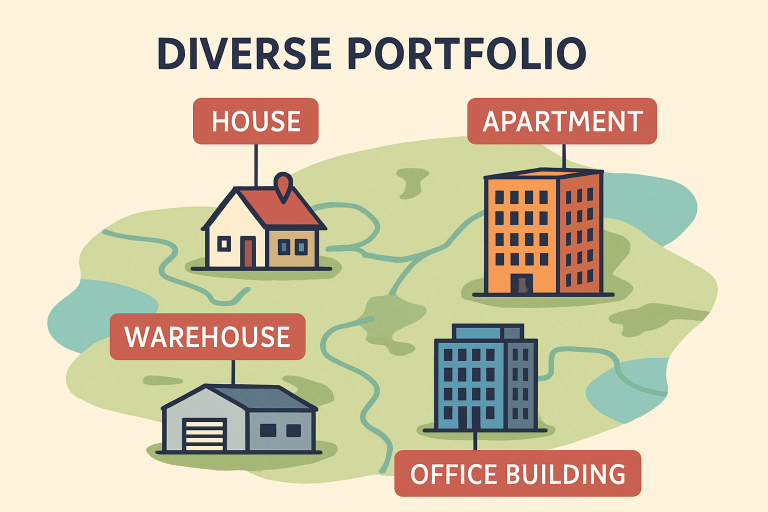
Beyond geography, real estate offers a diverse spectrum of asset types, including residential homes, multi-family buildings, commercial office spaces, retail centers, warehouses, and specialized properties such as medical facilities and self-storage units. Each type of property responds differently to market and economic cycles. A slowdown in office demand may not affect multifamily or industrial assets.
Capitalizing on Different Market Cycles
When you diversify among several property types, you can capitalize on varying market strengths. For instance, during economic booms, retail and office spaces often experience significant growth. In downturns, multifamily units and warehouses tend to remain resilient as people always need housing, and goods continue to require storage and shipping.
Tax Benefits
Property ownership delivers several compelling tax advantages. Notably, investors can deduct mortgage interest, operational expenses, and depreciation from their taxable income, which can substantially reduce their overall tax burden. In some cases, property owners can benefit from capital gains deferrals through 1031 exchanges, allowing them to reinvest profits and compound gains tax-efficiently. Certain credits, like historic rehabilitation or energy-efficiency incentives, may also be available, depending on the property’s use and location.
Long-Term Wealth Building
Real estate’s dual ability to generate income and appreciate makes it a cornerstone for lasting financial growth. While market cycles may ebb and flow, those holding real estate for extended periods are often rewarded with leveraged equity. Over decades, your properties can become significant assets, either through direct cash flow or by being refinanced or sold as part of a broader financial strategy. This long-term approach is why so many successful investors rely on property holdings to provide generational wealth.
Final Thoughts
Diversifying through property ownership provides investors with unique advantages—steady cash flow, capital appreciation, protection against inflation, and favorable tax treatment—all while mitigating the risks associated with less tangible investments. By incorporating a mix of property types and locations, and by leveraging professional advice from market leaders, you can construct a future-proof investment portfolio built to weather market shocks and deliver substantial long-term returns.